24/05/2026
An excellent Fiorini violin at the ALI stand: here's its story
26 set 2025
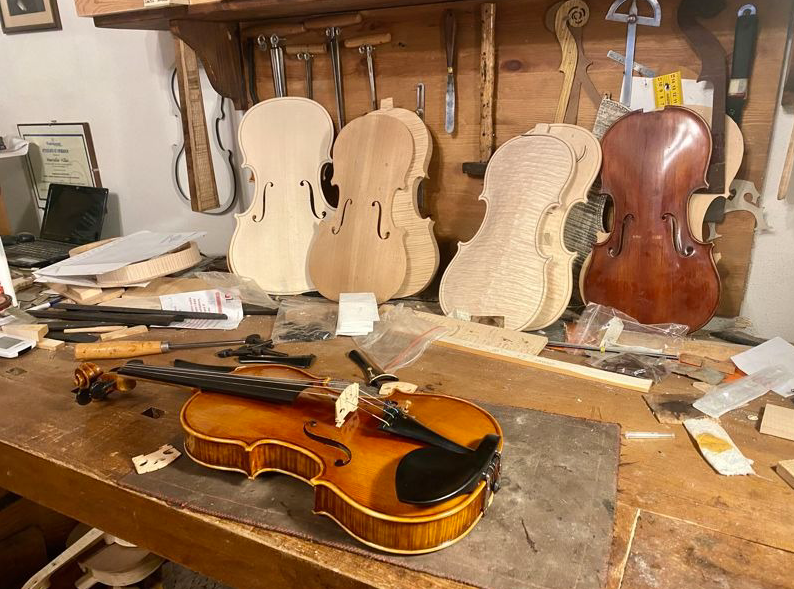
On the occasion of the Cremona Musica International Exhibitions and Festival 2025 edition, ALI (Associazione Liutaria Italiana) will be present at the Cremona exhibition center with a stand where, in addition to showcasing the work of the association’s members, it will continue its effort to raise historical awareness. Last year, this initiative highlighted the figure of Ansaldo Poggi through a conference and exhibition at the Museum of the Municipality of Medicina. This year, it will have the pleasure of hosting a rare 1897 violin by Raffaele Fiorini from Bologna.
Fiorini is considered the progenitor of the third golden age of violin making, following the Brescian/Bergamasque and Cremonese periods. Bolognese violin making undoubtedly opened the doors to the revival of 20th-century violin making. By “violin making,” we refer to a craft where manual skill is combined with artistic intuition to create a functional artifact—the musical instrument. The luthier who constructs these instruments can rightfully be regarded as an artist, a creator of works of art.
Already in the 17th and 18th centuries, Bologna was a particularly active hub for music and violin making. The Accademia Filarmonica of Bologna, founded by the noble Vincenzo Maria Carrati and located in Palazzo Carrati, is one of Europe’s oldest musical institutions, known for training musicians of worldwide fame such as W. A. Mozart and Carlo Broschi, known as Farinelli. At its peak, Bologna hosted nearly three hundred workshops of artisans dedicated to building musical instruments, particularly lutes and similar instruments, marking a flourishing period in local violin making.
However, today it is Cremona that is internationally recognized, famous for its historic craftsmen such as the Amati workshop and its successors, including Andrea Guarneri, Francesco Ruggeri, Antonio Stradivari, Domenico Montagnana, and others. Yet, by the late 18th century, Cremona faced a long period of decline; about a century later, only a few makers survived, including the Ceruti family, Pietro Grulli, Giuseppe Beltrami, and a few others.
Meanwhile, across Europe, schools of violin making emerged independently of Cremona, claiming their own prominence in the craft. In Italy, artisans engaged in instrument making continued in various regions, but often without achieving the same high level of perfection as in the past.
By the late 19th century, the Bolognese sphere initiated a turning point that would shape the 20th-century revival. In 1868, Raffaele Fiorini (1828–1898) moved with his family to Bologna. Until that year, he had worked as a miller in Bazzano, at the Mulino della Sega by the Torbido Canal, where in 1861 his son Giuseppe was born—who would later play a central role in reviving this ancient craft nationally and beyond.
In Bologna, Raffaele Fiorini opened a workshop in the historic center at the stables of Palazzo Pepoli, and within a few years, he became known as a skilled instrument maker. His instruments, though strong and personal in character, are refined in detail, with tightly arched soundboards, deeply carved scrolls finished with a subtle rounded bevel, elegantly tapered f-holes, and eyes shaped in graceful ovals. Fiorini’s varnish is soft and rich, with a deep reddish-brown hue. His violins and cellos were particularly appreciated by musicians of the local academy and gained recognition even overseas.
Where Fiorini acquired the knowledge to create such refined and resonant instruments is uncertain, as he was largely self-taught. It is believed that his connections with violin master Carlo Verardi and the Modenese Tadolini family of luthiers nurtured his innate abilities, though there is no definitive confirmation. Regardless, Fiorini’s fame spread, attracting young apprentices, including his son Giuseppe, alongside notable students such as Augusto Pollastri, Armando Monterumici, and Cesare and Oreste Candi, making him a true master teacher.
Raffaele’s relationship with Giuseppe was not easy, and they soon parted ways, with Giuseppe opening his own workshop in 1885. Giuseppe first gained recognition at the Milan exhibition of 1881, followed by a gold medal at Bologna’s 1888 International Exhibition celebrating the university’s 800th anniversary. In 1889, he moved to Munich on the advice of Andreas Rieger, a luthier and dealer of Mittenwald origin, marrying Rieger’s daughter and later inheriting his workshop upon Rieger’s death in 1896.
Giuseppe’s growing prestige in instrument making and ongoing demand for expert appraisals on antique instruments opened doors to the German Luthiers’ Confederation, where he eventually became president—a remarkable achievement for an Italian in Germany.
At the start of the 20th century, when Italy entered the war against Germany in 1915, Giuseppe Fiorini, aware of the difficulties this could pose, moved to Zurich, Switzerland, where his reputation as a great luthier allowed him to establish a new circle of disciples and friends. This network enabled him to acquire the Stradivari relics from Marchesa Paola Dalla Valle of Turin, vital for the revival of Italian violin making. Fiorini understood that to restore Italian violin making, one must study Stradivari’s work to refine construction methods and preserve the arc instrument tradition.
After lengthy negotiations, in 1920 the collection passed into Giuseppe Fiorini’s hands, with the promise to donate it to an Italian public institution. In 1923, he traveled to Rome intending to open a violin-making school, but severe eye disease thwarted this plan, leaving him nearly blind and forcing him to abandon the craft. Returning to Bologna and later moving to Munich, all treatments failed. He entrusted violin repairs to his student and friend Wolfgang Turcke-Bebie (1878–1958), who later became a skilled Bolognese luthier and had often assisted Fiorini during his absences.
In 1930, Fiorini donated his Stradivari collection to the Cremona Museum, ensuring it would be publicly displayed, with the goal of establishing a violin-making school under his direction. The donation, officially formalized on October 26, 1930, earned high praise from the mayor, who described it as “princely.” Giuseppe Fiorini passed away on January 24, 1934, in Munich and, according to his wishes, was buried on San Michele Island in Venice next to his mother Teresa Obici.
Among his most prominent students were Ansaldo Poggi, Paolo Morara, Turcke-Bebie, Giuseppe Castagnino, Pietro Messori, and Arrigo Tivoli-Fiorini. The rest, as they say, is history.
Galleria fotografica


Lorenzo Frignani
© Riproduzione riservata